Reseña del artículo sobre el uso de redes neuronales convolucionales para evaluar parámetros de red de materiales orgánicos
El artículo titulado «Convolutional Neural Networks to assist the assessment of lattice parameters from X-ray powder diffraction» presenta una innovadora metodología para la estimación de parámetros de celda en compuestos orgánicos utilizando redes neuronales convolucionales (CNNs). Los autores del estudio son Juan Iván Gómez-Peralta, Xim Bokhimi y Patricia Quintana-Owen, investigadores del CINVESTAV-IPN y la UNAM…
Comentarios sobre “estimación del bandgap mediante difracción de rayos X de polvos e Inteligencia Artificial”
Cuando apareció en mi mente por primera vez la idea de que quizás fuera posible estimar la brecha entre bandas (band-gap) de un material a partir de un patrón de difracción de polvos pensé que era una provocación. Provocación porque el tamaño de la brecha es un fenómeno que tiene que ver con transiciones cuantizadas…
Inteligencia Artificial aplicada a Ciencia de Materiales. Parte 2: Los bandgaps
Resumen: Esta entrada tiene como propósito principal informar sobre diversas estrategias implementadas en la caracterización de materiales cristalinos para el desarrollo de modelos de aprendizaje de máquina que estimen la brecha energética entre bandas (mejor conocida como bandgap, por su nombre en inglés). En general, quienes han desarrollado estos modelos de aprendizaje de máquina tienen…
Inteligencia Artificial aplicada a Ciencia de Materiales. Parte I
Desde hace meses he tenido ganas de escribir un Review sobre los trabajos que existen de aplicación de algoritmos de Inteligencia Artificial en Ciencia de Materiales y, aún más, hacerlo en castellano. Por diferentes razones he venido postergando su escritura. Este tiempo, en el que me he mantenido fuera, me ha servido para tomar la…
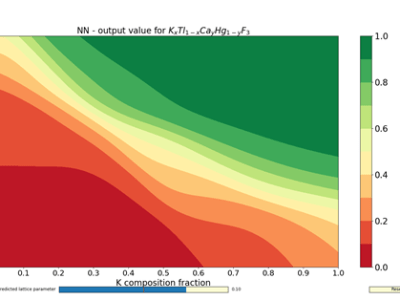
Modelling perovskite materials with ANNs beyond their composition: feature construction using their atomic arrangements.
Last week I showed you some results obtained with an Artificial Neural Network (ANN). The ANN classified the crystal compounds into perovskite or non-perovskite. The input data (features) fed to the ANN contained information about atomic radii, electronegativities, electronegativity differences and quotients of the atomic radii. All the features were constructed considering the number of…
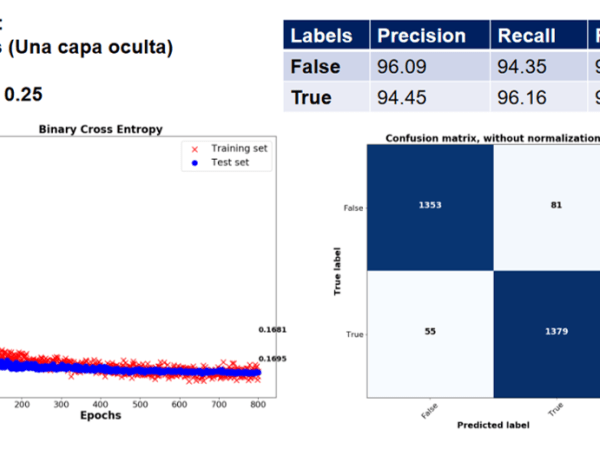
Symmetry-site based feature construction to characterize the crystal compounds. Part III.
I will explain some of the features used to characterize the crystal compounds into perovskite or non-perovskite structures. The constructed features were fed to different Artificial Neural Networks, which classify the crystal compounds in a binary fashion. These features are constructed using the different atom-environments in a crystal compound. These environments are known as Wyckoff…
Symmetry-site based feature construction to characterize the crystal compounds. Part II.
Let me show you what you can find with the approach I told you in the last post. 1629 vertex-shared perovskite compounds were found in Crystallography Open Database (COD) (Figure 1). As I told you, all crystal structures (such as the perovskite structure) are defined by the occupation of certain Wyckoff sites. In the last…
Symmetry-site based feature construction to characterize the crystal compounds. Part I.
My Ph. D. work was about the inference of new perovskite compounds with Artificial Intelligence and quantum chemical calculations. More concretely, I used Artificial Neural Networks (ANNs) to predict compounds having the perovskite crystal structure. The ANNs I worked with were full-connected and feed-forward (also known as multilayer perceptrons). The developed ANNs classified the crystal…
Artificial Intelligence in our life
Interview done at the Institute of Physics of National Autonomous University of Mexico (UNAM) during the Doors Open Day, on November 2019 (in spanish).
Get the most recent posts
Leave your email.
 gomezperalta.mx